
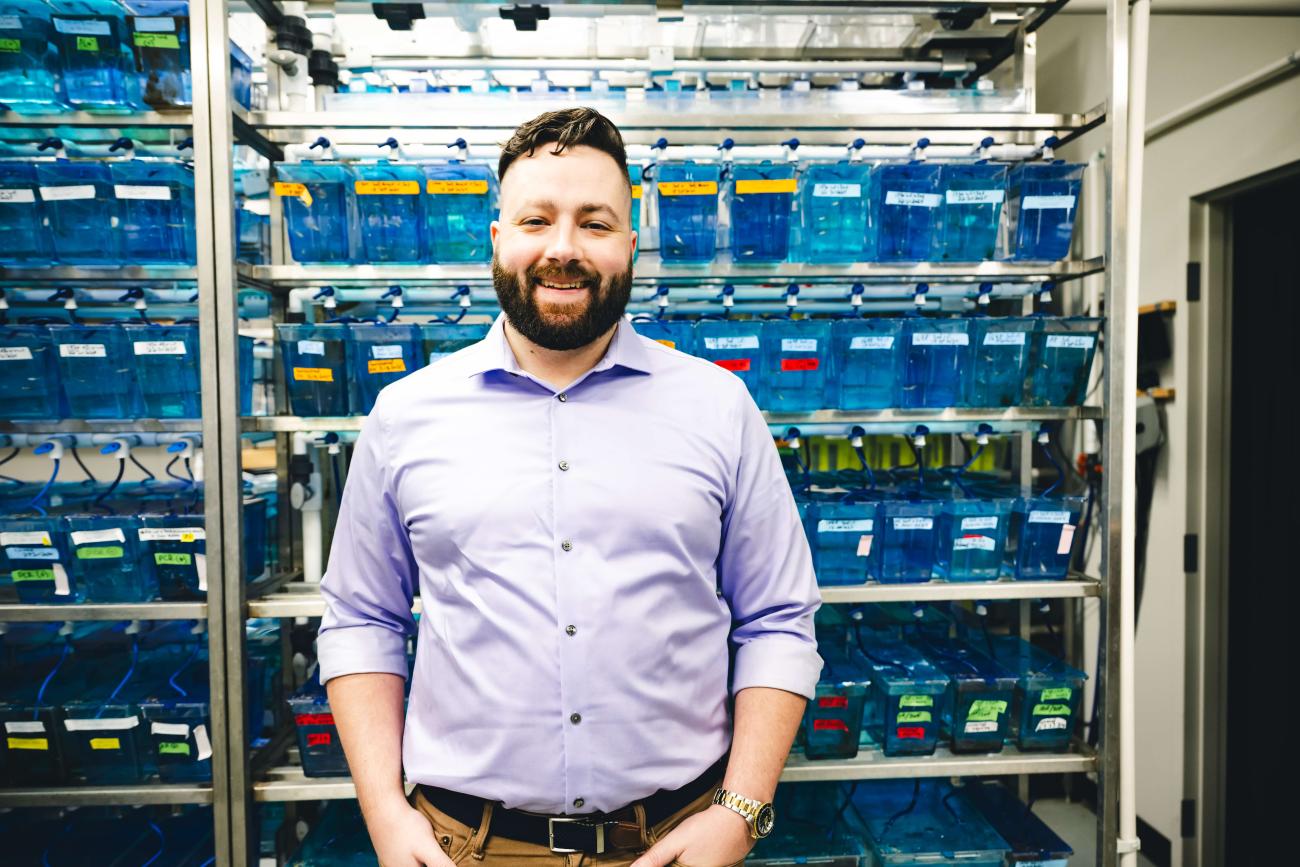
From Teaching to Discovery
Alexander Seaver’s academic journey finds balance through zebrafish genetics and student advocacy.
Like many kids, Alexander Seaver was curious and inquisitive. From a young age, he had a strong interest in science and understanding how things work. But unlike many kids who jump from one pursuit to another, his love of science never wavered, even when his path took unexpected turns. "It carried through into middle and high school, and it hit its stride when I attended [college] and became interested in medicine, but then really fell in love with hands-on research," he explains. Though his career at Lehigh would get off to a shaky start with COVID hitting just six months into his program, that early resilience and adaptability would serve him well. "That's what set me on the path of pursuing a career in science."
Driven by the goal of building a career as a research scientist, Seaver focused on building his CV. He earned his bachelor’s degree in molecular biology with a concentration in scientific computing from Kenyon College. Then his path diverted slightly. He taught sophomore biology and coached swimming at the Peddie School in Hightstown, N.J., then worked for a year as a manager and licensed pool operator at Meadowbrook Swim Club in Baltimore, Md. None of these roles directly related to research scientist career he was working toward. Neither was teaching K-12 in his original professional plan, but that was kind of the point.
“I knew I wanted to take a break between undergrad and grad school. I wanted to get out there and solidify what I wanted to do long-term,” he says. Over the course of his academic career, he found he loved mentoring and helping his fellow students understand difficult concepts. “Teaching seemed like a natural fit for that,” he says. “I didn’t plan to teach in the super long-term, but I loved every second of it. Teaching K-12 sparked my interest in teaching going forward, whatever that might look like, whether it’s in a mentorship position or at the undergraduate level.”
Admittedly, high school biology is a long way from the sophisticated research Seaver is conducting at Lehigh, but teaching had its own rewards. The subject matter wasn’t as complex as his current research, yet he found it rewarding.
“I was teaching tenth grade, so we were just starting to get into some of the complexities of foundational biology. High school, undergraduate, and graduate students require different things and learn in different ways, but it was still awesome to share my science knowledge with students at any level.”
Seaver came to Lehigh in 2019 as a doctoral student, where he rotated in the labs of professors Kathryn Iovine and Matthias Falk before joining Iovine’s lab full-time at the end of his first year. His work broadly focuses on understanding the pathways upstream of the gap junction protein connexin43 when injured zebrafish regenerate fins. Connexin43 mutations can cause zebrafish fins to grow shorter than normal, with smaller segments and fewer dividing cells. The research suggests that connexin43 helps coordinate two important processes, how much the fin skeleton grows and how it forms its joints and structure.
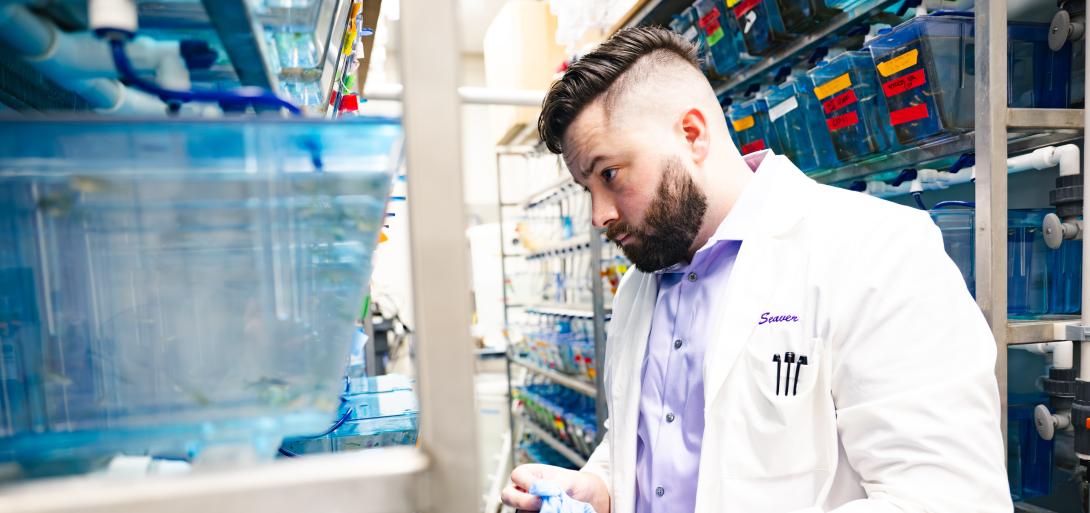
Seaver's classroom experiences have enhanced his lab work. "My teaching experience, along with other experiences, has taught me that everyone learns and picks things up differently," he says. His interest in zebrafish research began during his undergraduate years at the International Zebrafish Center in Eugene, Ore. "I got exposed to the fundamental aspects of zebrafish, so when I came to Lehigh, I hit the ground running. That was one draw for the research," he explains.
He was also attracted to the work in Iovine's lab. "The lab focuses on molecular biology and biochemistry at a very precise level—examining how key proteins and genetic factors function and their broader effects on the body," he says. Seaver is trying to solve, a single issue in a meticulous, focused way. Lehigh has given him the room and resources to conduct research in a way that suits him, he says. “To be able to come in and understand what one specific thing is doing and how it contributes to the whole—it was a really good fit,” he says.
Seaver has also left his mark at Lehigh in other ways. He served as president of the Biological Organization of Graduate Students (BOGS) after serving as treasurer. His tenure as president was slightly less demanding than his term as treasurer in 2020, at the height of COVID and a period of tremendous uncertainty. As president, his focus shifted to day-to-day concerns and working environments of biology graduate students to ultimately set them up for long-term success. BOGS worked to improve the student experience in the department. The organization also launched a series of professional development workshops that opened collaboration opportunities and gave graduate students a platform to practice presentations and build various skill sets.
“My time focused on helping the graduate student experience in biological sciences—hearing the voices of the students and taking it back to the faculty and administration. For instance, improving study spaces and offices. We want to prop up our graduate students to help them be as successful as they could be.”
Next, Seaver will begin a postdoctoral position at Lehigh in the lab of geneticist Wynn Meyer. Part of his job will be setting up the wet lab and doing some computational experiments. “It’s a shift in what I’ve been working on—more genomics and doing more computational work. Along with my experience in biochemistry and molecular biology, their lab has been working to validate some of their output of their computational work by doing wet lab work,” he explains.
Though Seaver’s career at Lehigh got off to a shaky start, it’s been a great experience, he says. “It’s been excellent to work with the faculty inside and outside the department. I feel I’ve been set up well for a career in biology going forward.”